It is Monday morning and I’m making one of my many drives from Belgium to Delft. As always I drive across the Haringvliet bridge and I immediately feel the effect of the wind on my car.
It’s difficult to keep the car on the road and I ask myself the question: what if my car is lighter, the effect of the wind is bigger, could I than keep the car still on the road? When I remember that designing a lightweight car is one of our targets with Nuna, I realize it’s vital to find a perfect balance between a car that’s as light as possible, but at the same time a save car.
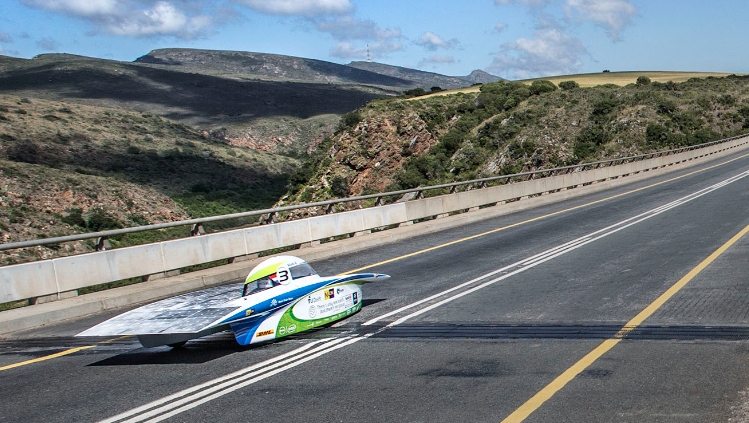
My name is Bart Helwig and I am one of the Mechanical Engineers of the Nuon Solar Team. Since September I work together with Thijs on the mechanics of Nuna. We don’t only strive for a light car, but also a car that can guarantee the safety of the driver. As you can read in the Blog of Thijs, we are looking for the limits of the car: can it be lighter and is it still save? But how do we do it?
Let me start at the beginning of the project, at the moment where we worked out some concepts so that we can choose the best concept. After the choice is made Jorden and Joris (Aerodynamics) began to design the perfect aerodynamic shell.
It became clear that it would be a challenge to design the suspension in the small space we’ve got. The first step of our design process is getting started in CATIA, a 3D modeling program. The first version is designed so that all parts are geometrical correct. That the tires are in the right place and that the connections are in the right places.
The next step is to set different requirements for our suspension. When calculating the suspension we altered various factors and evaluated on the basis of the established requirements. In this way we can look where weight can be saved or not.
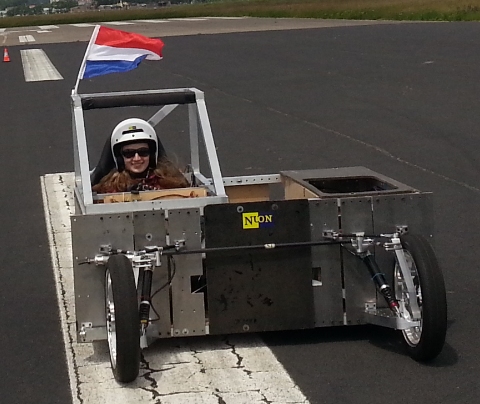
Once convinced that we designed as light as possible and still within our requirements, we send our parts to our manufacturer(ECN). When they come back the first thing you want to know is whether all parts fit in the car. But we don’t assemble all parts directly to our car. This for two reasons. The first is that the carbon body is finished later and secondly that the production of the one of a kind carbon body takes around 3 months. If something goes wrong during testing of the suspension there is a possibility that the body is non reparable and we need to make a new one. Therefore we test our suspension first on our test vehicle “Benny”, shown in picture below. We test on this aluminum frame our suspension to its max. Until we know if everything is designed well we put it on the carbon body.
In this way we try to search our limits , to become the winner of the WSC ’15.