You might think that the World Solar Challenge is all about building an excellent solar car. Obviously it is, but to win the Challenge, there is a lot more to do than that. Last Friday, I flew in with the Support Crew, to help preparing. These are all former Nuna team members who bring a lot of experience with them. We have a car in pretty tiptop shape, so now a huge amount of dedication is put into getting a million details right. It might not be necessary to drive the challenge, but it certainly is to win.
Convoy
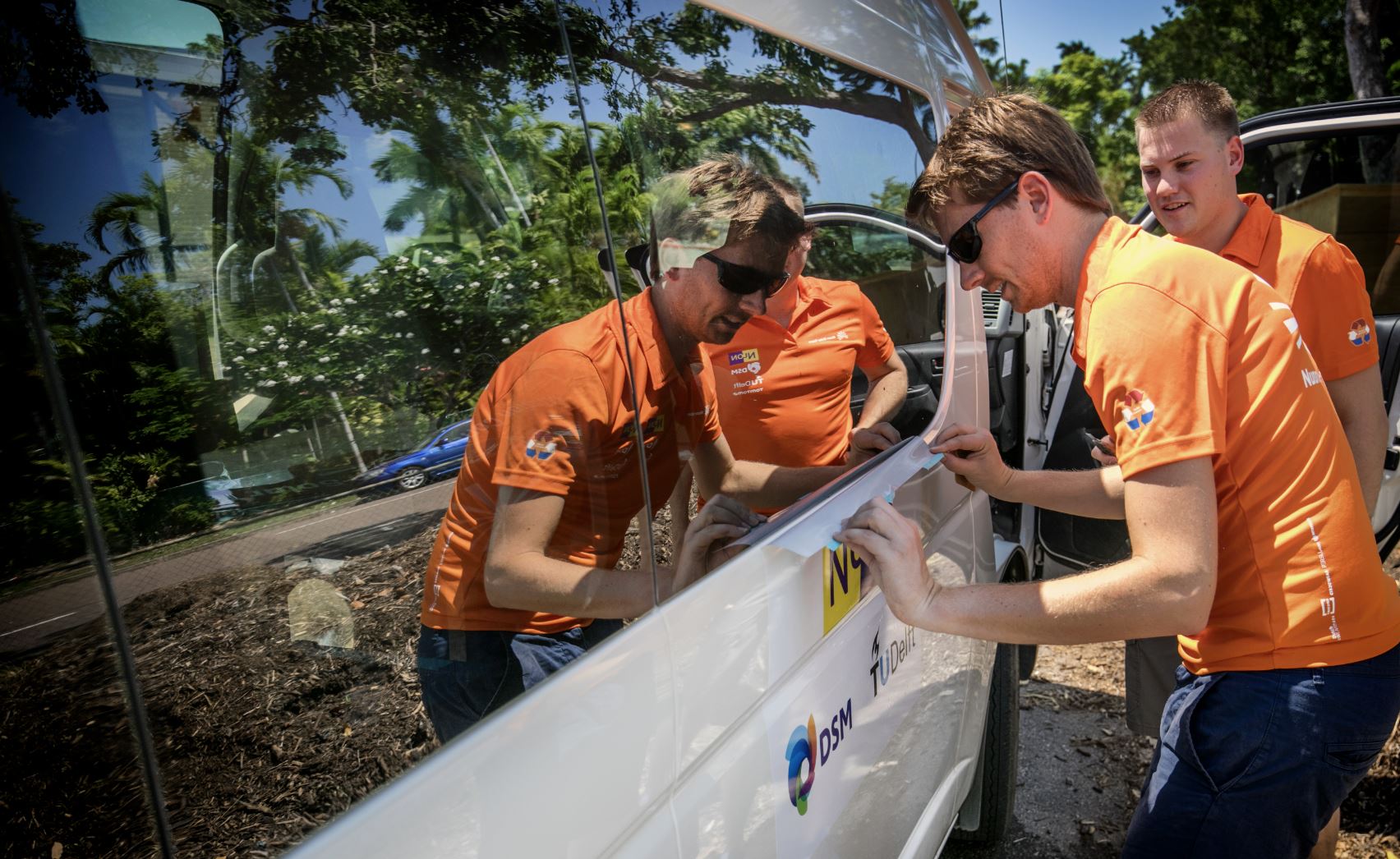
Much attention in the preparation is put into preparing the convoy. You don’t only need a solar car, but also vehicles to support it. The two most important, and mandatory, vehicles are called ‘Scout’ and ‘Mission Control’, but in fact there are quite a few more. All vehicles need to be stickered to indicate they are part of Nuon Solar Team, and have mandatory stickers to tell other road users which communication channel the team is using. This way, for instance other teams and the huge road trains that we share the road with can communicate with us in case of overtaking. Safety first, obviously.
Mission Control is by far the most work for the support crew, as it is the brain of the strategists, where all information (weather, road conditions, performance of the car) comes in and where decision on the strategy are made. Mission Control carries an array of antenna’s and a fair bit of computer power. This is far too much for the battery of the poor car, so it has a massive additional battery to deal with the additional electricity need.
Providing electricity is a major job in many other vehicles too, as we do things like meteo downloads or photo and video editing on the fly. As many readers recognise, quite a lot of equipment doesn’t charge well on 12V (Apple, ahem), most cars are therefore equipped with 220V. And dongles. And WiFi-antennas. And external satellite phone antennas. And… etc etc. Preparing the Convoy is a major job, and a major planning exercise as the cars are also used for various tasks, such as shopping. So it requires planning and oversight to make sure the cars are where we need them at the right times.
Reconnaissance
As the last editions have shown, the difference between winning or losing can really be minutes. Between Tokai and Nuon Solar Team last year, the time difference was for most of the Challenge less than 30 min. As winning is a matter of excluding the factor of bad luck as good as you can, the start is rehearsed by ‘Scout’ and ‘Mission Control’ exactly a week before, on Sunday morning. To find out which lanes are best to use and to make sure we can exit city traffic around Darwin as smoothly as possible. Although traffic in Australia is extremely light compared to the Netherlands, around cities it can be busy. Especially with over 40 solar team convoys leaving town. Precious minutes can be lost by making the wrong decisions.
Shopping!
A vital element of preparation is shopping. We will be in the outback for four or five days, camping in the middle of nowhere. Shopping is vital. This is not the usual Saturday shopping, but sometimes emptying complete shelfs of products in the supermarkets. A precious resource that many teams need is ‘Demi-water’, demineralised water. It is used to spray over solar arrays at control stops to keep the temperature down (and consequently: to maximise the output). Finding demi-water in October is pretty hopeless, as all top teams need it, so you better stock up early.
Using normal water, either bottled or tap, for that task is a really bad idea: the water evaporates and leaves a layer of salts on the array. Obviously, not good for its efficiency. It’s a great time for local shops with about 50 solar teams around. At J-Car, the local electronics shop, they keep a list of the solar teams that visited them, which is probably all of them.
Details, details, details
And then a million details. Bianca, PR, found out that the phones we use for livestreaming become very hot on the dashboard, despite air conditioning. A problem that was sorted with a quick fix: a simple fan blowing air over it. We need 4 pairs of gardening gloves, with rubber on the inside. Why? Because your hands get very slippery when it is 40 degrees, and the last thing you want is drop your solar car out of your hands. So we buy minimum 8 pairs. Things get lost.
You can’t win the World Solar Challenge with all these preparations. But you sure can lose it, if you don’t get it right.
By Michel van Baal, spokesman TU Delft.
