A solar vehicle is packed with cutting-edge technology and high-end research, ranging from a light-weight suspension to an aerodynamic body. For many of these aspects one will find that coming up with the concepts is extremely difficult, but handling them once in place is relatively easy. Should one ever encounter a dent in the body then there is no other option but to grab some filler and smoothen the surface again. Do you hear a scratching sound when Nuna moves? Find the bothering spot and fix the problem. There is one discipline though where one could only wish things were so easy: welcome to the wonderous world of electrical engineering…
In the special field that is electrical engineering things are not always as easy as one would expect, and turn out to be such that they spin your head around. Whereas in mechanical engineering the left rear and right front wheel have nothing to do with one another in both theory and practise, electrical components often seem to be unrelated in theory only. The electric motor and driver’s headphone could both function perfectly when kept apart, but cause absolute havoc when placed in a car together. When experts come rushing in and start yelling terms such as interference, phase-currents, CAN-identifiers and connectors the non-expert will quickly be lost. The world of electrical engineering is fascinating though, so in this blog we’ll give a short introduction on the electrical system of a solar vehicle.
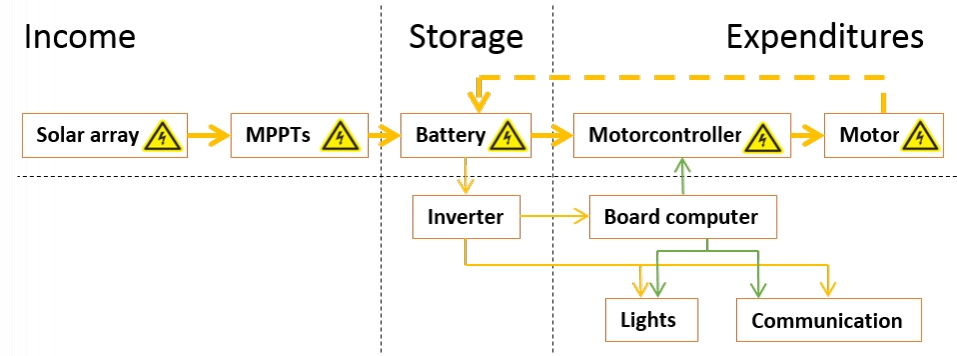
“I’ve tried to keep the scheme simple”, Bas van Wee (one of the designers of the electrical system) tells, “but even then I needed this many blocks”. A tricky system it is indeed, but Bas walks us through. “In a central position is the car’s battery pack, the place where all energy is stored. Energy can be expended to many components, however there are just two ways in which energy can enter the battery: through the solar array and through the engine. The latter process only happens when we brake using the regenerative function of the engine. This is only done sporadically however, so I’ve dashed the line. The solar array is because of this probably one of the most important parts in the electrical system of a solar car.”
Energy from the solar array does not enter the battery pack directly, but is first put through Maximum Power Point Trackers (or MPPTs for short). Renzo Plaisant van der Wal, designer of the solar array, explains: “MPPTs are devices to maximise energy income from our solar array. A solar array generates high voltage and little current, or high current and little voltage. The optimal power income however (the product of current and voltage) is somewhere in the middle, so these devices track that optimal ‘average’ in order to guarantee maximum solar income.”
The primary expenditure of energy from the battery pack naturally goes to the electric engine, Nunas source of power. The amount of ‘throttle’ (or actually: current) to be applied is determined by the driver through a pedal on his steering wheel, and this signal is relayed to the motor controller by the board computer. “To make for easy representation I’ve drawn all currents in yellow, and signals in green” explains Bas. “The motor controller is the link between the battery pack and the engine, ensuring we can accelerate in a controlled manner and keep a fixed speed for long stretches. Now that we’ve covered all high-voltage components (those components accompanied by a lightning bolt) and all paths of high currents (the thick yellow arrows) I think it’s time to move on to the low-power system.”
“Controlling Nuna requires a command system” Casper van Wezel (our third electrical engineer) adds, “that’s where the board computer comes into play. This board computer receives its power from an inverter, which drains some energy from the battery pack. The amount of energy here is far lower and is therefore indicated by thin yellow arrows. All these components one could touch with bare hands without consequence, however we always shut down the car when disconnecting any wires just to be sure. The board computer issues essential instructions to other vehicle components, such as the motor controller mentioned earlier, the lighting and the driver’s headphone. In this way all the commands a driver issues through his steering wheel can be relayed by the board computer, and be executed where necessary.”
“I hope we’ve been able to make a distinction within our solar vehicle between energy income, storage and expenditure, and give an impression of all the stuff happening in the electrical system of a solar car”, Renzo wonders. “Should there be interest in further explanation we can always dive into the system deeper in a next blog”, Bas adds. He can’t help but joke (with a wink): “Can I use the words ‘mosfet’ and ‘induction’ then?”
